
Wysa Review: 2026 Overview
The verdict
4.1/ 5 A penguin-fronted AI that runs CBT exercises through conversation, with human coaching one step behind.
Wysa does one thing unusually well: it holds a real CBT-style conversation rather than handing you a worksheet. The no-cost AI layer is genuinely useful and the method credentials are solid. Where it falls short is breadth and staying power — no habit builder, no widget, and the chat loops grow familiar fast. If you want a broader toolkit, Liven or Headspace serve that better; if CBT-style dialogue is specifically what you are after, Wysa earns its place.
Wysa is an AI chatbot that guides you through CBT and DBT exercises via text conversation, fronted by a small cartoon penguin. The no-cost tier gives you genuine access to the chat and a library of exercises — not a locked demo. That alone puts it ahead of several rivals that offer a taster before hitting a paywall.
The app sits on iOS and Android, rated around 4.8 on the App Store and 4.5 on Google Play at the time of writing. Our score is 4.1 out of 5 — strong on method and personalisation, held back by limited breadth and a stickiness problem that shows up past week two.
What Wysa actually does
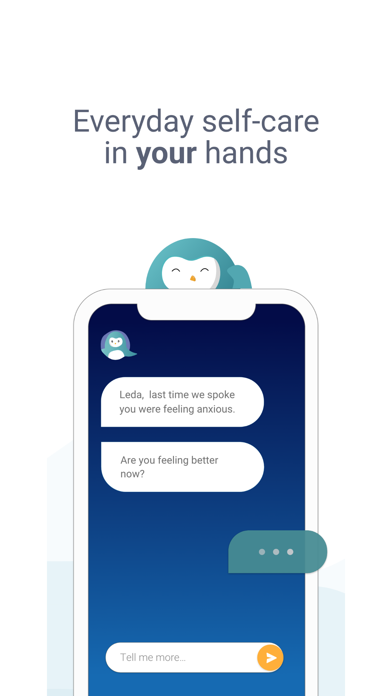
The core is a conversational AI that asks how you are, listens to what you type, and guides you into a relevant exercise — a thought record, a breathing technique, a DBT skill, a short body scan. It is not freeform chat. Wysa has structure: it moves you from stating a problem toward doing something about it.
Around that conversation sits mood tracking, a journal, meditation content, soundscapes and periodic assessments. None of those feel bolted on, but none of them is the reason you would choose Wysa over a dedicated meditation or journaling app. The conversation layer is the differentiator. Human coaching is a paid add-on, separate from Premium.
First session: what to expect
Wysa opens with a brief onboarding covering current mood and what you want to work on — sleep, stress, anxiety, relationships. No email required upfront. Within a few messages you are doing an actual exercise, not being sold at. Our time-to-first-value score is 4 out of 5.
Setup personalisation is lighter than apps like Liven, which runs a thorough intake before building your plan. The penguin character is present from the start and cannot be changed — worth knowing before you download.
The conversation layer: where Wysa earns its rating
Most AI wellness chatbots give generic responses or hand you a static list of tips. Wysa follows a more deliberate arc: it reflects what you said, identifies a cognitive pattern, then suggests a specific technique. The CBT influence is visible in that sequence, not hidden behind vague wellbeing language. DBT skills appear when the situation calls for them.
Over time, the loops grow familiar. After several weeks the same exercises come up in similar situations, and responses can feel predictable. That is partly structural — any self-guided AI tool has this ceiling. Worth knowing before committing to a year's subscription.
Mood tracking, journaling and assessments
The mood tracker connects to your chat history in a way a standalone tracker like Daylio cannot — Wysa can reference recent mood patterns mid-conversation. Journaling is basic by comparison: notes are stored, but without the AI-generated follow-up prompts Rosebud or Reflectly offer.
Periodic assessments on anxiety, sleep and mood are more clinically structured than the emoji-based logs common elsewhere. They add a layer of self-monitoring worth watching over months.
Method and credibility: named frameworks, not marketing copy
Wysa's method score is 4.3 out of 5 — the highest in the AI companion category we reviewed. CBT, DBT and mindfulness are named frameworks with verifiable bodies of research, and Wysa's exercises map onto them recognisably. Published peer-reviewed research and deployment in regulated healthcare settings give more to evaluate than a vague science-backed claim.
A self-guided AI doing CBT-style exercises is still not the same as working with a CBT therapist, and Wysa does not claim otherwise. No human accountability on the no-cost tier; the coaching add-on changes that, but only if you pay.
Pricing: the no-cost tier is the real story
Real conversations, exercises and mood tracking are available without a subscription. That is not the case for most competitors — Youper limits AI sessions quickly before asking you to subscribe. Premium is around $99.99 per year at the time of writing; confirm current prices in the App Store or Google Play. Human coaching is priced on top of that.
Cancellation goes through your app-store subscription, and the no-cost chat remains afterwards. At the higher end of this category's price range, Premium makes most sense for users doing the exercises consistently — breadth does not justify the cost for casual users.
Day-to-day feel past week two
Stickiness is 3 out of 5. The conversational format is engaging in week one, but by week three patterns emerge and novelty wears thin. There is no streaks system, no habit builder, no widget to keep the app top-of-mind. Apps that survive past week two in our testing tend to have a gamification loop, a structural daily trigger, or a community. Wysa has none of those.
For some users that is fine — a tool you reach for when you need it, not one that demands daily engagement. But if consistent practice through the app's own design is what you need, be realistic about that gap.
How Wysa sits alongside Liven, Youper and Replika
Liven (4.5, our top pick) beats Wysa on breadth: habit builder, widget, courses, AI companion, journaling and mood tracking in a guided personal plan. Wysa wins on the depth and quality of CBT-style conversation. Youper is the closest direct rival — also AI-led and CBT-focused — with a more restricted no-cost tier; Wysa edges it on method credibility in our rubric. Against Replika, an open-ended companion chatbot with no CBT structure, Wysa is the more purposeful tool if structured exercises are your goal.
Privacy posture
Wysa has published documentation on anonymisation and data handling, and has operated in regulated healthcare contexts that impose stricter requirements than most consumer apps face. That context is worth something.
It is not a substitute for reading the current privacy policy yourself before sharing detailed emotional content. Policies are updated and data-sharing arrangements change.
Who should — and should not — download Wysa
Wysa suits people who want to work through anxious or low-mood periods using structured CBT and DBT, who prefer conversation to tapping through static content, and who are comfortable with self-guided tools. The no-cost tier makes it low-risk to try.
It is a poorer fit if you want a broad personal development platform, daily-habit reinforcement, or something that pulls you back through its own design. These are everyday-wellbeing tools — not substitutes for professional support when that is what the situation calls for.
Maker: Wysa · Platforms: iOS, Android · Approach: Self-guided AI, optional human coaching · Methods: CBT, DBT, mindfulness
Wysa plans & pricing
Free tier: Generous free AI chat and exercises.
Trial: Free core; paid for premium packs and human coaching.
Prices approximate, as of June 2026 — verify on the App Store / Google Play. Premium content packs and live human coaching are paid; the AI chat is largely free.
Cancellation: Cancel through your app-store subscription; the free chat remains.
Feature checklist
- Mood trackingYes
- JournalingYes
- AI companionYes
- Courses & lessonsYes
- MeditationsYes
- Soundscapes / focus musicYes
- Habit & routine builder—
- RemindersYes
- Quiz / assessmentYes
- Community—
- Live coachingPaid coaching
- Crisis resourcesYes
- Data export—
- Apple Health / Google Fit—
- Home-screen widgets—
- Offline usePartial
Wysa pros & cons
What's good
- Generous no-cost AI chat — the core tool works without a subscription
- Named CBT, DBT and mindfulness frameworks, not vague evidence-inspired language
- Mood tracking, journaling, assessments and meditations alongside the chat
- Optional paid human coaching for when you want a real person involved
- Around 4.8 App Store and 4.5 Google Play at the time of writing
- Crisis resources built in throughout
What to weigh up
- No habit builder — the app does not track or reinforce daily routines
- No home-screen widget, which matters for low-friction daily check-ins
- Premium around $99.99/year — higher than several broader rivals
- Human coaching priced separately on top of Premium
- Stickiness 3/5: chat format becomes repetitive after the first few weeks
Support
Wysa offers in-app support and a help centre; response times are not prominently stated. The human coaching tier gives direct access to a real coach — a different matter from general customer support.
Method & credibility
Wysa names CBT, DBT and mindfulness as its frameworks — specific enough to be verifiable. The app has published peer-reviewed research and has been used in workplace and healthcare contexts, though self-guided tools always warrant reading the evidence critically rather than taking it at face value.
Privacy & data
Wysa has published documentation on anonymisation and data handling, and has operated in regulated healthcare contexts. Policies change, so read the current privacy policy before sharing detailed emotional content — facts here are hedged as of June 2026.
Third-party ratings
- 4.8 / 5 on App Store — as of June 2026, verify
- 4.5 / 5 on Google Play — as of June 2026, verify
We report independent ratings with their source and date and never invent them. Figures here are approximate and pending verification before launch.
Our data: Wysa
Two numbers we measure ourselves, on the same 1–5 scale for every app — the things most roundups never score (see all 20 on the compare page):
Wysa FAQ
Is Wysa genuinely free to use?
The AI chat and a range of exercises are available without a subscription — a meaningful no-cost tier, not a locked demo. Premium content packs and human coaching require payment. Confirm current details in the App Store or Google Play.
How does Wysa's AI compare to a real therapist?
They are different things. Wysa guides structured CBT- and DBT-style exercises, but cannot diagnose, cannot follow up on your progress between sessions, and cannot handle serious clinical concerns. It is a self-guided support tool, not a replacement for professional care.
What does the Premium plan cost?
Around $99.99 per year at the time of writing, with human coaching priced separately. Confirm current prices in the App Store or Google Play before committing.
Does Wysa work offline?
Partially. Some content may be accessible offline, but the AI conversation requires a connection.
How does Wysa handle a crisis mention?
Wysa includes crisis resources and safety protocols that recognise certain keywords and signpost toward real help. The app will direct you to dedicated services if the situation calls for it.
Can I cancel Wysa Premium easily?
Cancel through your App Store or Google Play subscription settings. The no-cost AI chat remains available afterwards.