
Reflectly Review: 2026 Overview
The verdict
3.7/ 5 A guided journaling app that pairs daily mood check-ins with AI-generated prompts to keep you writing.
Reflectly does one thing reasonably well: it gets you writing each day without requiring much initiative on your part. The prompts are decent, the interface is pleasant, and the mood-plus-journal combination works naturally. Where it falls short is depth — there are no courses, no habit builder, and the AI stays at the surface. At around $59.99 a year (at the time of writing; confirm in the App Store or Google Play), it asks a premium price for a tool that many users will outgrow by month three.
Reflectly is a journaling app with a single, clear premise: show up each day, answer a few guided questions, log how you feel, and let the app build a record of your inner life over time. There is no course library, no habit tracker, no AI companion to talk back to you. What you get is a streamlined write-and-reflect loop dressed in a soft, visually appealing interface.
That focus is both the app's main strength and its main limitation. For someone who keeps opening a blank notes app and staring at the cursor, Reflectly's prompts are genuinely useful. For someone who wants to do more than journal, the app will feel thin after a few weeks. Our score of 3.7 out of 5 reflects that it does its narrow job capably, but the price puts it in competition with tools that do considerably more.

What Reflectly actually is
Reflectly is built around a daily journaling session. You open the app, log your mood on a simple scale, and the app responds with a sequence of prompts — questions about your day, your feelings, things you are grateful for, or situations you want to process. You type your responses, and the app saves them. That is broadly it.
The 'AI' label in the app's marketing refers to this prompt-selection layer. The app adapts which questions it shows you based on your mood input and past patterns. It is not a conversational AI that reads what you write and responds; it picks from a library of prompts. That distinction matters if you are comparing Reflectly to tools like Rosebud or Liven's AI companion, where the model actually engages with the content of your entries.
Reflectly also shows mood charts and basic pattern summaries over time — a useful feature for anyone tracking emotional trends across weeks or months. The stats are not deeply analytical, but they are readable and motivating enough to encourage consistency.
Setup and the first session
Getting started takes under three minutes. You set a daily reminder time, pick a visual theme, and you are in. There is no lengthy onboarding quiz, no goal-mapping exercise, no upsell sequence to navigate first. The first journaling session begins almost immediately.
Time to first value is 4 out of 5 on our scale — you are writing a genuine reflection within minutes of installing. The simplicity here is real. Compare that to apps that spend ten minutes asking about your goals before you see any content, and Reflectly's approach feels refreshingly direct.
The free tier lets you try the core flow, but most prompts, themes and stats sit behind the subscription. The trial converts automatically, so set a reminder before the renewal date if you want to evaluate it without committing.
The daily journaling flow in practice
Each session opens with a mood selector — a face on a sliding scale — followed by a short series of prompts. The questions are varied enough that they do not feel identical day to day: some are gratitude-focused, others are more forward-looking, and some probe specific events you flagged as stressful. The sequence rarely runs longer than five to eight minutes at a normal writing pace.
The prompts are the app's strongest asset. Reflectly has clearly put effort into writing questions that feel personal rather than generic. You are not answering 'What happened today?' every single time. That variety is what keeps the daily habit alive past the first fortnight — which is exactly the week-two hurdle we measure for stickiness. Our stickiness score is 3 out of 5, reflecting that some users stay and some drop off once the novelty settles.
One practical gap: there is no way to add images, links or audio to entries. If rich journaling matters to you — photos from your day, voice memos, attached documents — Day One is a more capable tool for that.
Mood tracking and what the stats show you
Mood logging is woven into journaling rather than sitting in a separate tab, which is a sensible design choice. You rate your mood before writing, and the app correlates those ratings with your entries over time. The result is a mood history chart that gives you a visual sense of how your weeks and months have trended.
The stats are pleasant to look at but not particularly deep. You can see streaks, your average mood by day of the week, and a word-cloud derived from your entries. What you cannot do is export any of this data — a meaningful limitation if you ever want to take your history elsewhere or analyse it outside the app.
For pure mood tracking without journaling, Daylio does a more thorough job at a considerably lower price. Reflectly is the better choice when you want mood and writing to stay connected in one session.
Where the AI label gets complicated
The 'AI journaling' category carries an expectation that the app will do something intelligent with what you write. Reflectly does not quite meet that expectation. The prompts are adaptive in the sense that they respond to your mood score, but the app does not read your prose and reflect it back to you, spot cognitive patterns, or ask a follow-up based on something you disclosed.
Rosebud, which scores 3.9 on our ranking, sits closer to that ideal of a journal that actually listens. Its AI reads entries and responds with contextual follow-ups. Reflectly's AI is closer to a smart shuffle of a prompt library, personalised by your mood input rather than by your written content.
That is not disqualifying — the prompts work, and they work consistently — but it is worth knowing what you are paying for. If you want a journal that talks back, Reflectly is not that.
Method and credibility: positive psychology in practice
Reflectly frames itself around positive psychology, a legitimate and well-researched field concerned with wellbeing, strengths and meaning. Gratitude prompts, reflection on positive experiences, and mood awareness are all consistent with that tradition.
The app does not, however, cite specific tools, validated questionnaires, or named protocols the way more evidence-grounded apps do. There are no references to Cognitive Behavioural Therapy, Acceptance and Commitment Therapy, or equivalent structured frameworks. Our method score is 3.2 out of 5 — the approach is credible in broad terms but loosely applied. For an everyday wellbeing journaling tool, that is sufficient; if you are looking for structured psychological support, this is not where to find it.
Pricing and what you get for it
Reflectly offers a free trial that converts to a subscription. At the time of writing, the Premium yearly plan runs around $59.99 — confirm the current price in the App Store or Google Play before subscribing, as it can vary by region and promotion. Most prompts, all statistics and the visual themes sit behind that paywall.
That price puts Reflectly alongside Liven (from around $59.99 per year on its Premium plan), which offers mood tracking, journaling, an AI companion that responds to your entries, courses, habit building, meditations and more. It also sits near Stoic (around $49.99 per year), which at least provides a distinctive philosophical framework and data export. For a journaling-only tool, around $60 a year is a difficult proposition.
Daylio covers mood tracking and micro-journaling for around $23.99 a year and includes data export. If your core need is logging entries and seeing mood patterns, the price gap is hard to ignore.
How Reflectly compares to Rosebud and Day One
Among dedicated journaling apps, Reflectly occupies a middle ground. Day One (score: 4.0) is the richer tool for anyone who wants a genuine private journal — multiple journals, photos, audio, rich formatting, and solid data export. It is particularly strong on Apple devices. Reflectly is simpler and more prompt-led, which suits beginners but frustrates anyone with more demanding requirements.
Rosebud (score: 3.9) beats Reflectly on the AI dimension: it uses a language model to read your entries and respond with contextual questions, surfacing patterns you might miss. Reflectly's prompt system cannot do that. Rosebud also offers data export. The trade-off is that Rosebud's interface is more conversational and less visual — Reflectly looks better.
If you want something broader still, Liven (score: 4.5, our top pick) includes journaling, mood tracking, an AI companion that actually engages with your entries, plus courses, habits and meditations. The onboarding is heavier and the upsell pressure is more pronounced, but for the same annual outlay you get a considerably wider toolkit.
Day-to-day experience and design
Reflectly is genuinely pleasant to use. The colour gradients, typography and animation have been thoughtfully considered — opening the app feels calming rather than demanding. That matters for a journaling habit, because friction at the moment of opening is what kills most people's streaks.
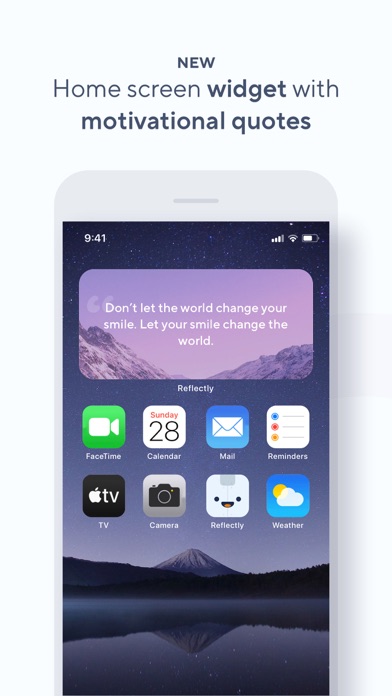
The widget adds a visible prompt on your home screen without requiring a full app launch. Reminders are customisable by time and frequency. The overall experience is polished in a way that belies the app's relatively narrow feature set.
Where the daily feel gets frustrating is the paywall. On the limited free tier, you hit restrictions quickly — a prompt you cannot access, a theme you cannot apply, a stat you cannot see. The app's design implies generosity; the subscription terms are less so.
Privacy: what to check before you write
Journal entries sit among the most personal data you could hand to an app: they can reveal mood states, relationships, stressors and thought patterns in fine detail. Reflectly stores entries in the cloud, which is necessary for cross-device access but means your data lives on their servers.
The app has a published privacy policy; reading it before you start journaling is worthwhile, particularly the sections on data sharing and retention. There is no end-to-end encryption marketed as a feature, unlike Day One which makes encryption a selling point. If privacy is a priority, that difference is worth weighing.
Who should and should not use Reflectly
Reflectly is well suited to someone who wants to start a journaling habit and finds blank pages difficult. The prompts remove the hardest part of daily writing, and the mood-plus-journal combination gives you something to look back on after a few weeks. If you are in that early stage and want an uncomplicated, good-looking app, Reflectly does what it says.
It is less suited to anyone who wants depth beyond journaling, is price-sensitive, or expects the AI to actually engage with their entries. Users who have been journaling for a while will likely find the prompts limiting. Anyone who cares about data portability should also note the absence of an export function — you cannot easily take your entries elsewhere.
At 3.7 out of 5 on our overall score, Reflectly is a capable but overpriced journaling tool. It earns its place on our list for doing the basics well; it earns its rank of 19 by doing only the basics.
Maker: Reflectly ApS · Platforms: iOS, Android · Approach: Self-guided · Methods: journaling, positive psychology
Reflectly plans & pricing
Free tier: Limited free; most features behind a subscription.
Trial: Free trial that converts to a subscription.
Prices approximate, as of June 2026 — verify on the App Store / Google Play. Most prompts, stats and themes require Premium.
Cancellation: Cancel through your app-store subscription. Reviews note the trial converts quickly, so check the renewal date.
Feature checklist
- Mood trackingYes
- JournalingYes
- AI companionPrompts
- Courses & lessons—
- Meditations—
- Soundscapes / focus music—
- Habit & routine builder—
- RemindersYes
- Quiz / assessment—
- Community—
- Live coaching—
- Crisis resources—
- Data export—
- Apple Health / Google Fit—
- Home-screen widgetsYes
- Offline usePartial
Reflectly pros & cons
What's good
- Prompt-led journaling removes the blank-page barrier immediately
- Mood logging and journaling are unified in a single flow, not separate tabs
- Clean, calm visual design that makes the daily check-in feel low-friction
- Home-screen widget keeps the habit visible without opening the app
- App Store rating around 4.6 at the time of writing, suggesting most users enjoy the experience
What to weigh up
- No courses, meditations, habit builder, or health-app sync — it is purely a journal
- AI assistance is limited to pre-set prompt selection; it does not respond to what you write
- No export feature, so your entries are locked inside the app
- Premium pricing of around $59.99 per year is hard to justify against more capable rivals at a similar price
- The trial converts quickly — several user reviews flag unexpected charges if they miss the renewal date
Support
Reflectly offers in-app support and an email contact route; a help centre exists on the web. Response times are not publicly stated, so expect standard indie-app turnaround rather than same-day replies.
Method & credibility
Reflectly cites positive psychology as its guiding framework, which is a recognised field. However, the app does not reference specific protocols or peer-reviewed tools the way CBT-based apps do — the connection between its prompts and any named framework is more asserted than demonstrated.
Privacy & data
Reflectly collects journal entries and mood data, which are among the more sensitive categories of personal information. The app has a published privacy policy, but as with any journaling tool, it is worth reading it — particularly sections on data sharing and cloud storage — before you commit personal reflections to it.
Third-party ratings
- 4.6 / 5 on App Store — as of June 2026, verify
- 4.3 / 5 on Google Play — as of June 2026, verify
We report independent ratings with their source and date and never invent them. Figures here are approximate and pending verification before launch.
Our data: Reflectly
Two numbers we measure ourselves, on the same 1–5 scale for every app — the things most roundups never score (see all 20 on the compare page):
Reflectly FAQ
Does Reflectly have a no-cost version?
There is a limited free tier and a trial period, but most features — prompts beyond the basics, mood statistics and themes — sit behind the Premium subscription. The trial converts automatically, so note the renewal date when you start and decide before then whether to continue.
How much does Reflectly cost?
At the time of writing, the Premium yearly plan is around $59.99. Prices can vary by region and promotion, so confirm the current figure in the App Store or Google Play before subscribing.
Can I export my Reflectly journal entries?
No — Reflectly does not currently offer a data export feature. Your entries are stored in the app and cannot easily be moved to another service. If data portability matters to you, Day One or Daylio are better alternatives.
Is Reflectly's AI actually conversational?
Not in the way that term usually implies. The AI selects and adapts prompts based on your mood input and usage patterns, but it does not read your written entries and respond to them. Rosebud and Liven's AI companion are closer to a genuine conversational experience.
How does Reflectly compare to Daylio for mood tracking?
Daylio is faster for pure mood logging — you tap icons rather than write paragraphs — and costs considerably less, with a more capable stats layer and data export included. Reflectly is the better choice when you want journaling and mood tracking in one connected flow rather than quick icon-style check-ins.
Is Reflectly suitable for managing serious mental health concerns?
Reflectly is a journaling and reflection tool, not a mental health service. It is not a substitute for professional support. The app does not offer crisis resources, therapeutic protocols or access to qualified practitioners.