
How We Feel Review: 2026 Overview
The verdict
4.0/ 5 A nonprofit mood tracker with a richer emotion vocabulary than anything else at this price — which is nothing.
How We Feel is the most science-grounded mood tracker you can get without paying a penny, and first value arrives in under a minute. The catch is scope: there are no courses, no habit builder, no AI companion, and the experience plateaus once you have a month of data. If you want mood tracking and nothing else, it is hard to beat. If you want growth tools alongside it, you will outgrow it quickly.
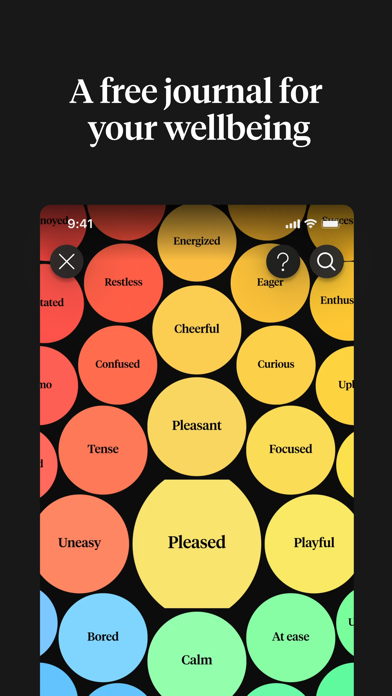
Most mood-tracking apps treat emotion as a slider: bad, okay, good. How We Feel takes a different view. Open the app and you are presented with an emotion wheel that distinguishes between, say, 'irritable' and 'angry', or 'content' and 'joyful'. That level of granularity is not decoration — naming an emotion precisely has a real basis in emotional regulation research, and the app leans into it rather than hiding behind generic wellness copy.
What makes How We Feel unusual in this space is that it is run by a nonprofit, costs nothing, and has no paid tier lurking behind a paywall. The business model, such as it is, appears to be research and impact rather than subscription revenue. That shapes the whole experience: there is no upsell, no trial that converts, no prompt to upgrade. You get the full app on day one — which also means you get all of it, and all of it is mood tracking.
Who How We Feel actually suits
The app suits people who want a focused tool for emotional self-awareness and nothing else. If you are already using a habit app, a journaling app, or a meditation app, this slots in without overlap. It is also a strong choice for anyone sceptical about paying for a mood tracker when the core act — pausing to notice how you feel — costs nothing.
Students, people on tight budgets, and anyone who has had a frustrating experience cancelling a wellness subscription will find the no-subscription model quietly refreshing. The app does not suit people who want coaching, guided programs, or a single tool that covers their whole wellbeing practice.
Setup and first check-in
Setup is minimal: pick a name, set a reminder frequency, done. No quiz, no goal-setting sequence, no onboarding funnel. The first check-in is available within about thirty seconds of install — a time-to-first-value score of 5 out of 5 in our rubric.
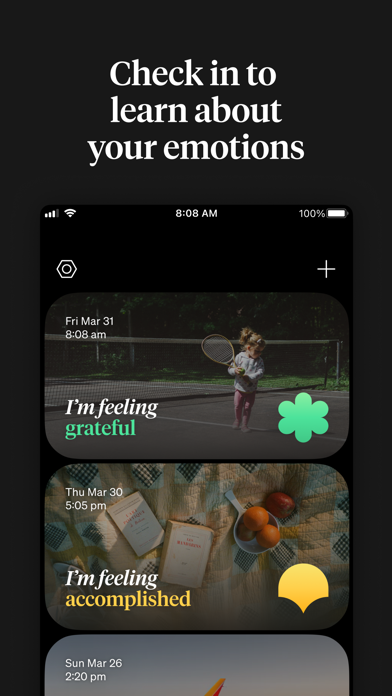
You indicate energy level (low to high) and valence (unpleasant to pleasant), and the emotion wheel narrows to a cluster of specific emotions. Pick one, add an optional note, and you are finished. The whole flow takes under two minutes once you know it.
The emotion wheel in practice
This is the centrepiece of the app. Where Daylio gives you five mood faces, How We Feel gives you a structured taxonomy: 'anxious', 'overwhelmed', 'stressed', 'worried', and 'scared' are all distinct options rather than collapsed into one colour. That specificity changes how you use the log — you end up thinking more carefully about what you are actually feeling.
The wheel is grounded in circumplex models of emotion from affective science, mapping feelings onto axes of arousal and valence rather than just positive/negative. The app explains this briefly without being didactic. In day-to-day use it stays quick: under a minute once you have the pattern down, with the optional note field available but never required.
Skill tips, exercises, and the limits of depth
Beyond logging, How We Feel surfaces short skill tips and brief exercises — breathing techniques, grounding prompts, simple reframes — linked loosely to what you have logged. These are closer to reference cards than a course, and they will feel thin if you are coming from Wysa or Youper, which layer proper guided sequences around similar content.
Journaling is limited to brief notes attached to check-ins, not freeform writing. If you want a proper journal alongside your mood log, Day One or Rosebud fill that gap without conflict.
Patterns, insights, and long-term tracking
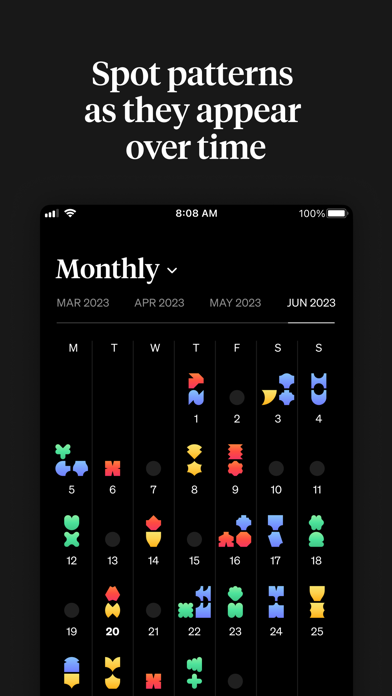
After a few weeks of consistent logging, How We Feel surfaces time-of-day trends, weekly summaries, and activity-mood correlations. The charts are clean and readable, and data export is available — better than many paid apps manage. Health sync and offline mode work smoothly.
This is where the stickiness question becomes honest. Our stickiness score is 3 out of 5. The emotion wheel is engaging at first — many people log several times a day early on. By week six, logging tends to settle into once-daily or less, and the insights plateau because the app has no mechanism to respond to your patterns. It tracks; it does not adapt.
Method and credibility
Our evidence score for How We Feel is 4.2 out of 5 — the third-highest in our current ranking, behind only Headspace and Wysa. That reflects one specific strength: the app names its researchers, cites the conceptual model it uses, and does not make inflated claims about outcomes. That is a higher bar of transparency than most apps in this space clear.
What the score does not claim is that the app delivers structured therapy. It tracks emotions using a credible vocabulary but does not guide you through CBT, DBT, or any named therapeutic framework in depth. The evidence backing is for the taxonomy, not for a treatment approach. If clinical credibility is what you need, Wysa or Youper are better suited.
Pricing: no cost, no catch
There is nothing to price. The app is entirely no-cost — no subscription, no in-app purchases, no premium features hidden behind a paywall. This is a nonprofit project, so the model is not 'no-cost tier that converts'. Our value score is 4.9 out of 5, the joint-highest in our ranking.
The only honest caveat on value is the obvious one: you get what you pay for in terms of scope. The no-cost model means no team of content writers producing courses, no AI team building a companion, no coaching tier. If you need that breadth, you will be paying for a different app. But for mood tracking specifically, the cost-per-feature calculation is unambiguous.
How it compares to Daylio
Daylio is the other strong contender in the low-cost mood-tracking space, and the two apps suit slightly different people. Daylio's emoji system is faster to log and easier to build into a reflex. How We Feel's emotion wheel takes slightly more thought but produces richer data. Daylio has better habit and activity tracking; How We Feel has better emotion vocabulary and a clearer science story.
Daylio costs around $2.99/month or about $23.99/year for Premium (figures from our facts file; verify current prices in the App Store or Google Play). How We Feel costs nothing. If price is the deciding factor, the choice is clear. If you want activity tracking alongside your mood log, Daylio is worth the modest cost.
How it compares to Liven and all-in-one apps
Liven is our current number-one pick, and the gap in scope is significant. Liven includes mood tracking, journaling, courses, guided programs, an AI companion, and habit tools, all behind a subscription starting at around $59.99 per year. How We Feel does mood tracking at no cost.
There is a real case for running both. Liven's built-in mood check-in is functional but not as nuanced as How We Feel's emotion wheel. If you are already a Liven subscriber who cares about emotional granularity, using How We Feel for mood logs and Liven for everything else is a sensible setup. If you want growth across multiple areas of your life and are comfortable paying for it, Liven is the better call. If mood tracking alone is the goal and budget matters, How We Feel beats everything on this list.
Privacy and the nonprofit model
How We Feel is a nonprofit project, and its relationship with user data appears oriented around research rather than advertising. The app does not run ads. Emotional data collected is described as being used to improve understanding of emotional wellbeing at a population level, with individual data anonymised.
That framing is more reassuring than many commercial apps, but 'anonymised research data' is a category worth understanding before you start logging sensitive emotional states. Read the current privacy policy on the How We Feel website — the specifics matter here, and they can change.
Our verdict on How We Feel
How We Feel earns a 4.0 out of 5 from us — the same score as Day One and Youper, and higher than Daylio despite being entirely no-cost. The score reflects what it does well: an outstanding emotion vocabulary, solid science backing, data export, and a first-run experience measured in seconds.
The ceiling is real. No AI companion, no habit tools, no guided programs, no meaningful journaling. Stickiness is moderate — engaging at first, then settling into a background habit. Get it if you want the best standalone mood tracker at no cost. Look elsewhere if you want your mood data to connect to growth programs, coaching, or an AI that responds to what you find.
Maker: The How We Feel Project · Platforms: iOS, Android · Approach: Self-guided · Methods: mood tracking, emotion regulation
How We Feel plans & pricing
Free tier: Completely free — it's a nonprofit project.
Trial: No subscription; free.
Prices approximate, as of June 2026 — verify on the App Store / Google Play. Nothing — the full app is free.
Cancellation: No subscription to cancel.
Feature checklist
- Mood trackingYes
- JournalingNotes
- AI companion—
- Courses & lessonsSkill tips
- MeditationsExercises
- Soundscapes / focus music—
- Habit & routine builder—
- RemindersYes
- Quiz / assessment—
- Community—
- Live coaching—
- Crisis resourcesYes
- Data exportYes
- Apple Health / Google FitYes
- Home-screen widgetsYes
- Offline useYes
How We Feel pros & cons
What's good
- Completely no-cost — no subscription tier, no upsell, no paywall anywhere
- Emotion wheel covers dozens of named feelings, far beyond the usual happy/sad/anxious trio
- Science backing is explicit: named researchers and a validated emotion vocabulary
- Clean, calm interface that takes under a minute to log an entry
- Exports your data, syncs with Apple Health, and works offline
- Crisis resources built in, with no subscription required to access them
What to weigh up
- No habit builder, courses, AI companion, or guided programs — mood tracking only
- Journaling is limited to brief notes attached to check-ins, not freeform writing
- Personalisation is shallow; the app does not adapt or coach based on your patterns
- Stickiness tends to drop after the first month once the novelty of the emotion wheel settles
- No soundscapes, meditations beyond basic breathing, or social features
Support
How We Feel is a nonprofit project, so support options are more limited than a commercial app. The website has an FAQ and a contact form; response times are unclear. There is no in-app live chat or help desk.
Method & credibility
The app is backed by a named research team and uses an emotion vocabulary grounded in published affective science, citing specific researchers rather than vague references to 'experts'. This puts it ahead of most competitors on transparency — though the app itself does not deliver structured therapeutic techniques such as CBT or DBT protocols.
Privacy & data
As a nonprofit research project, How We Feel collects anonymised emotional data that may inform its research mission. The posture appears more transparent than most commercial apps, but emotional data is sensitive regardless of who holds it. Read the current privacy policy before you start logging.
Third-party ratings
- 4.8 / 5 on App Store — as of June 2026, verify
- 4.6 / 5 on Google Play — as of June 2026, verify
We report independent ratings with their source and date and never invent them. Figures here are approximate and pending verification before launch.
Our data: How We Feel
Two numbers we measure ourselves, on the same 1–5 scale for every app — the things most roundups never score (see all 20 on the compare page):
How We Feel FAQ
Is How We Feel really free with no hidden subscription?
Yes, at the time of writing the app is fully no-cost with no paid tier at all. It is run as a nonprofit project. There is nothing to subscribe to and nothing to cancel. Confirm the current situation in the App Store or Google Play, as this could change.
Who made How We Feel?
The app was developed by The How We Feel Project, a nonprofit initiative backed by researchers in emotion science. The project is transparent about its collaborators and research goals, which is part of why we rate its evidence score highly relative to commercial apps.
How does the emotion wheel work?
You indicate your energy level (low to high) and valence (unpleasant to pleasant) on two axes, and the wheel narrows to a cluster of specific emotions that match that combination. You then select the word that fits best. The system is based on circumplex models of emotion from affective science.
Can I export my mood data from How We Feel?
Yes, data export is available — one of the features that puts it ahead of some paid competitors. You can also sync with Apple Health. Check the current app for the exact export format and how to access it.
How does How We Feel compare to Daylio?
How We Feel has a richer emotion vocabulary and a more explicit science story. Daylio is faster to log, has better activity tracking alongside mood, and has a stronger habit-adjacent feature set — at a small annual cost. If emotional granularity is the priority and budget matters, How We Feel wins. If you want activity tags and habit context alongside mood data, Daylio is worth considering.
Is How We Feel suitable if I'm already using Liven?
It can work alongside Liven rather than replacing it. Liven's mood check-in is functional but less granular than How We Feel's emotion wheel. Some people run both: How We Feel for mood logging, Liven for journaling, courses, and habit tools. They do not obviously conflict.