
Headspace Review: 2026 Overview
The verdict
4.4/ 5 A polished meditation and mindfulness app with structured courses, sleep tools, and one of the best-designed experiences in the category.
Headspace is the meditation app most people should try first. The teaching quality is high, the design is genuinely calming, and it scores 4.4 out of 5 on our rubric. Where it falls short is breadth: if you want journaling, habit tracking, or a personalised growth plan, you will hit its edges quickly. For pure meditation and sleep content, though, it is hard to beat.
Headspace has been teaching people to meditate for well over a decade, and it shows. The app has a coherence many competitors lack: every screen, every session, every piece of copy feels like it came from the same place. You open it, find something useful within thirty seconds, and you are done before the kettle has boiled.
Our overall score is 4.4 out of 5 — second-highest in this ranking. Its evidence and UX subscores are among the strongest we recorded. The trade-off is depth and personalisation, which sit lower. Headspace is a meditation app, not a life-improvement platform, and that distinction matters for what you choose.
Who Headspace is actually for
The clearest use case is a newcomer to meditation who wants to be taught rather than left to explore a catalogue. Headspace's beginner course explains what mindfulness is and why the techniques work — it is not just somebody telling you to breathe slowly over ambient music.
It is a weaker fit if you want accountability, habit building, or something that adapts as you grow. Headspace will not quiz you on your goals, build a programme around your answers, or track whether you are progressing on anything beyond a meditation streak.
Getting started: the first run
Sign-up is quick. You pick a primary goal — stress, sleep, focus, anxiety — and the app surfaces relevant starting points. No lengthy intake quiz. You can be in your first session within two minutes of downloading.
Our time-to-first-value rating is 4 out of 5. The caveat is that most course content requires a subscription, so the no-cost version gives you a taste rather than a full meal. The annual plan commonly comes with a free trial — confirm the current offer in the App Store or Google Play. A web app is also available, which not every competitor offers.
The meditation library and how it is organised
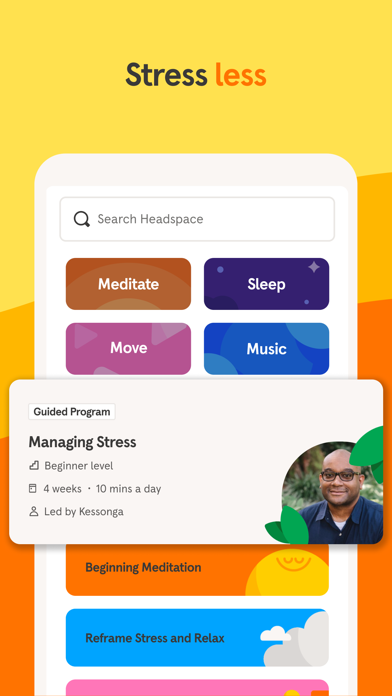
The core library is built around structured courses rather than a flat audio catalogue. Basics, the introductory series, walks you through the fundamentals session by session. Themed packs then cover focus, relationships, anxiety, and more. The progression feels considered: each session builds on the last.
Single meditations range from one minute to thirty-plus, covering commutes, lunch-break resets, and longer weekend practices. The voicework quality is consistently high. You can also browse by topic, mood, or duration if you prefer to dip rather than follow a course.
Sleep content: sleepcasts, music, and wind-downs
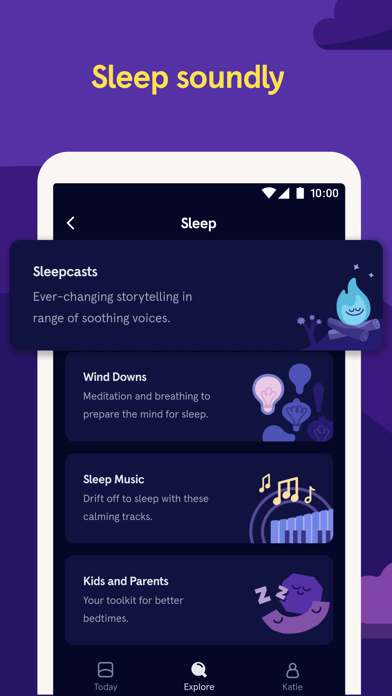
Sleep is arguably where Headspace punches hardest. Sleepcasts — long-form ambient narratives designed to redirect an overactive mind — are a distinctive format that many users say outperforms plain white noise. Wind-down exercises and sleep music round out the offering.
If broken sleep is what drove you to download a wellness app, this portion of the library is worth the subscription on its own for a lot of people. The offline download option matters here: you do not want a buffering sleep soundtrack.
Day-to-day feel and the two-week test
Our stickiness score is 4 out of 5 — solid, not exceptional. Headspace keeps most subscribers past week two without relying on gamification or social hooks. Each session feels complete in itself: no cliffhanger, no to-do list. That suits people who want a mindfulness practice to be calm and bounded.
The mood check-in feature is light — a simple post-session log, without the charting you get from a dedicated tracker. Do not choose Headspace expecting to understand your emotional patterns over time.
Method and credibility
Headspace names mindfulness and guided meditation as its methods and has published research with academic institutions on the effects of its content — a stronger evidence posture than most consumer wellness apps. The consumer app is self-guided wellbeing content, not clinical care; Headspace's clinical services for employers are a separate product. Our evidence subscore is 4.6 out of 5, the highest in the meditation category among apps we reviewed.
Pricing and what the subscription unlocks
Headspace runs at around $12.99 per month or around $69.99 per year at the time of writing — confirm current prices in the App Store or Google Play. The annual plan commonly includes a free trial. The no-cost content is limited to a handful of sessions; the trial is the real evaluation window. Cancellation through your app store is generally reported as straightforward.
What Headspace does not do
No journaling, no habit builder, no assessment that builds a plan around your goals. The AI companion (Ebb) is available in some markets at the time of writing — do not rely on it being present in your region. Health sync and home-screen widgets are supported, which helps with building a daily routine.
How Headspace compares to its closest rivals
Against Calm, the most direct competitor, Headspace's edge is structured teaching and stickiness (4 vs 3 on our rubric). Calm's sleep stories are a flagship and its aesthetic is slightly warmer. Both sit at a similar price.
Against Liven, our top-ranked app at 4.5 overall, Headspace wins on UX and evidence but loses on depth. Liven combines mood tracking, journaling, habit building, courses, and an AI companion in one place. For pure meditation, Headspace. For a broader toolkit, Liven edges it.
Privacy at a glance
Headspace collects usage and behavioural data and, at the time of writing, describes sharing it with third-party analytics and advertising partners. Specifics vary by region and change over time — read the current policy at headspace.com before signing up, particularly if you plan to use the app for sensitive personal content.
Maker: Headspace Inc. · Platforms: iOS, Android, Web · Approach: Self-guided (separate clinical care offered to organisations) · Methods: mindfulness, guided meditation
Headspace plans & pricing
Free tier: Limited free content; most courses are paid.
Trial: Free trial commonly offered on the annual plan.
Prices approximate, as of June 2026 — verify on the App Store / Google Play. Most courses, the full sleep library and the structured programs require a subscription.
Cancellation: Cancel through your app-store subscription; the annual plan is straightforward to manage.
Feature checklist
- Mood trackingYes
- Journaling—
- AI companionEbb (in some markets)
- Courses & lessonsYes
- MeditationsYes
- Soundscapes / focus musicYes
- Habit & routine builder—
- RemindersYes
- Quiz / assessment—
- Community—
- Live coaching—
- Crisis resourcesYes
- Data export—
- Apple Health / Google FitYes
- Home-screen widgetsYes
- Offline useYes
Headspace pros & cons
What's good
- One of the highest evidence scores in the category — methods grounded in mindfulness research
- Exceptional UX: clean, consistent design with near-zero friction
- Beginner courses are genuinely instructive, not just soothing background noise
- Sleep content — sleepcasts, music, wind-downs — is a real strength
- Offline access included, useful for commuters and travellers
- App Store rating of around 4.8 at the time of writing
What to weigh up
- No journaling; mood tracking is a light post-session log, not a proper record
- No habit builder and no goal-setting tools
- Personalisation is modest compared with adaptive-plan apps
- Priced similarly to broader all-in-one apps at around $69.99 per year
- No-cost content is limited; the trial is the real evaluation window
Support
Headspace offers a help centre and in-app support options. Response quality and speed are generally reported as reasonable, though support for billing queries runs through your app store rather than Headspace directly.
Method & credibility
Headspace names mindfulness and guided meditation as its methods and has published research partnerships in this area — one of the more credible evidence postures in the consumer meditation space. It does not claim clinical outcomes, and the self-guided app is distinct from the separate organisational clinical-care service.
Privacy & data
As with most subscription wellness apps, Headspace collects usage data and may share it with third-party analytics providers. We recommend reading the current privacy policy on the Headspace website before signing up, particularly if you plan to use the app for sensitive personal material.
Third-party ratings
- 4.8 / 5 on App Store — as of June 2026, verify
- 4.4 / 5 on Google Play — as of June 2026, verify
We report independent ratings with their source and date and never invent them. Figures here are approximate and pending verification before launch.
Our data: Headspace
Two numbers we measure ourselves, on the same 1–5 scale for every app — the things most roundups never score (see all 20 on the compare page):
Headspace FAQ
Is Headspace good for complete beginners to meditation?
Yes. The Basics course explains the reasoning behind the techniques rather than just guiding you through them, which helps the practice stick. No prior experience needed.
Can I use Headspace offline?
Yes. Downloaded content plays without a connection, useful for commuting or travel. Offline access is included in the standard subscription.
How much does Headspace cost?
Around $12.99 per month or around $69.99 per year at the time of writing. Check the App Store or Google Play for the current price — a free trial is commonly offered on the annual plan.
How does Headspace compare to Calm?
Both are strong at a similar price. Headspace has the edge for structured teaching and stickiness; Calm's sleep stories are a flagship feature and its design is slightly warmer. Try both free trials.
Does Headspace have journaling or habit tracking?
No. Mood check-ins exist but are basic; there is no journaling or habit-building feature. Consider Liven if you want both in one app.
Is the Headspace AI companion (Ebb) available everywhere?
Ebb is available in some markets at the time of writing but availability varies by region. Check your local App Store or Google Play listing before relying on it.