
Daylio Review: 2026 Overview
The verdict
3.9/ 5 Daylio strips mood tracking to its bare minimum: tap an emoji, pick a few activities, done in under twenty seconds.
Daylio is the sharpest, leanest mood tracker available at this price point. It delivers genuine insight from almost zero effort, and that is genuinely rare. Where it falls short is depth: there are no courses, no AI companion, no guided framework, and no health integrations — so if you want more than a data layer, you will hit the ceiling fast.
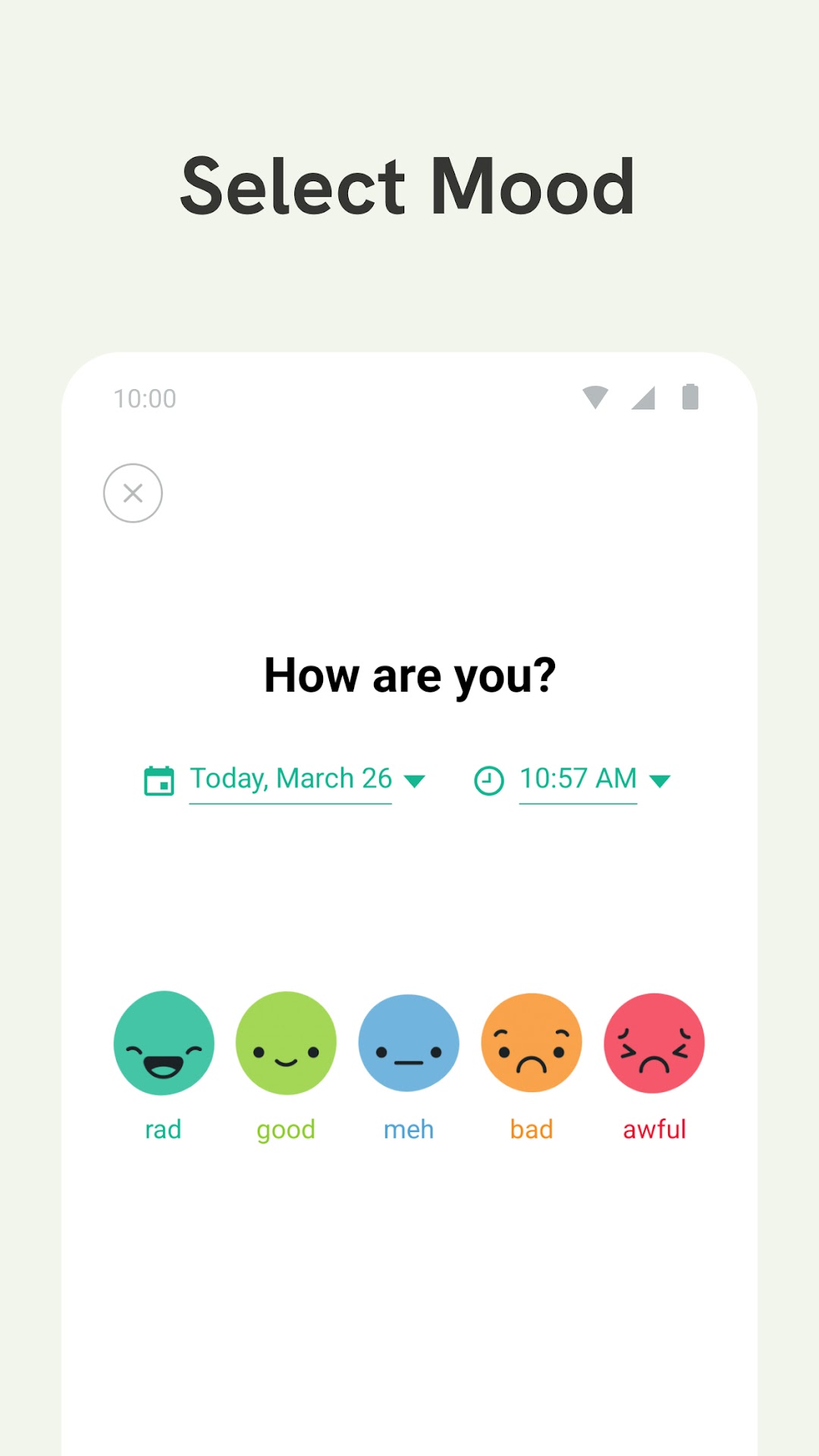
Most mood-tracking apps try to be too many things. Daylio went the other way. You open it, tap a face that matches how you feel, tick a handful of activities — exercise, work, coffee, whatever you actually did — and close it. The whole ritual takes less time than unlocking your phone properly. That simplicity is the point, and it is executed better here than almost anywhere else.
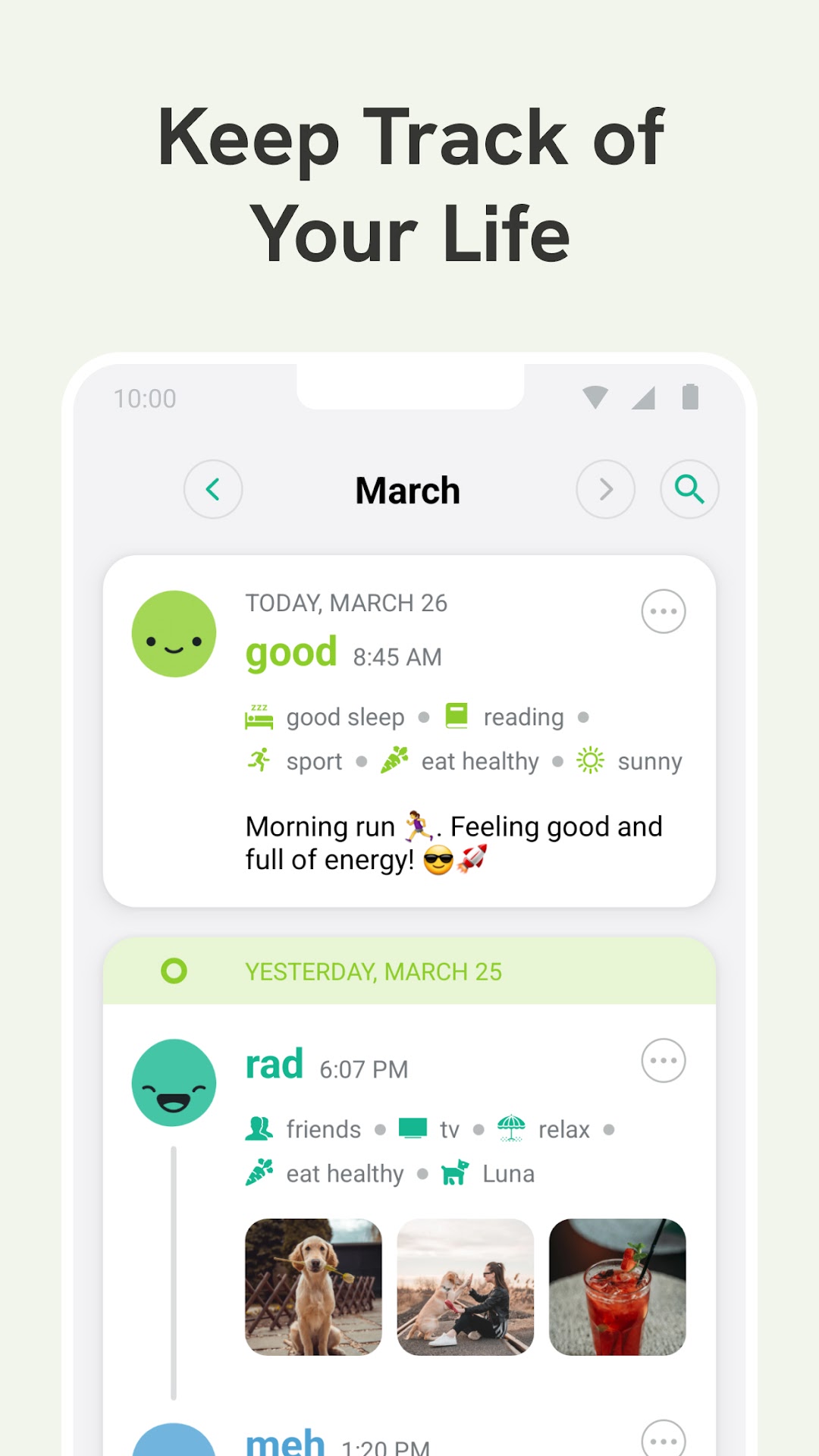
After a few weeks of consistent use, the stats screen starts to earn its keep. You can see that your mood dips reliably on Sundays, or that exercise entries correlate strongly with your better days. None of that requires any writing. Daylio's case for itself is not that it replaces reflection, but that it makes the data collection frictionless enough that reflection actually happens.
What Daylio is and who it suits
Daylio (developed by Reletech) is a mood diary and micro-journal available on iOS and Android. At its core it is a logging tool: you record how you feel several times a day using a five-point mood scale, attach activity tags, and optionally write a short note. That is the entire loop.
It suits people who want a low-friction record of their emotional patterns but not a guided programme. Students, busy workers, and people who have tried journaling apps and found them too demanding tend to get on well with it. It does not suit anyone who wants coaching, structured content, or a framework to work through — there is nothing like that on offer.
Setup and first five minutes
There is no lengthy onboarding quiz. You download the app, choose your mood icons (or keep the defaults), set a reminder if you want one, and log your first entry. Our time-to-first-value score here is a 5 out of 5 — about as fast as any app on our list.
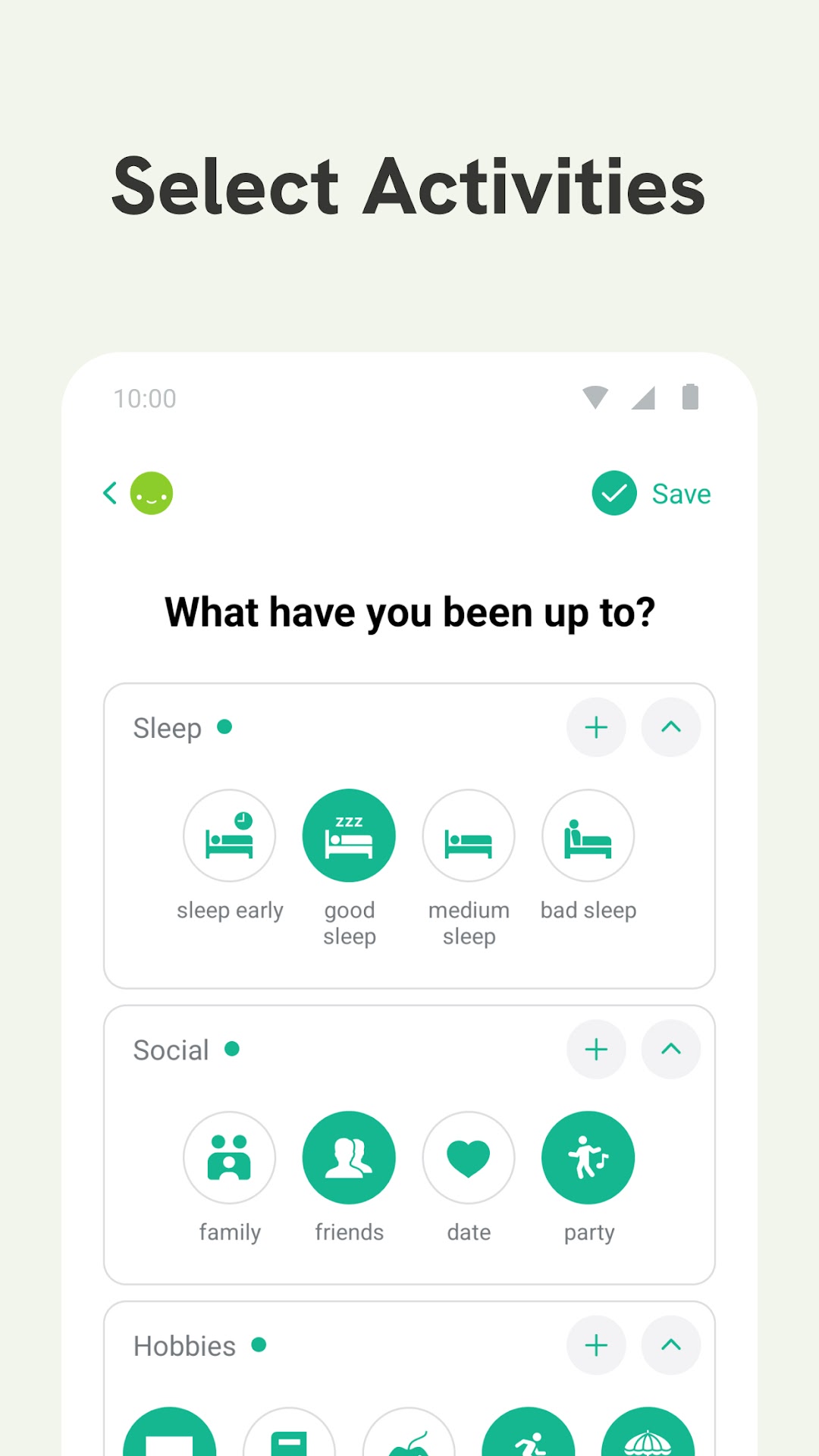
The activity library ships with sensible defaults — sport, food, family, work, sleep — and you can add your own in seconds. The customisation is genuine: emoji, colour, grouping. You can have your setup match exactly how you think about your day, which matters more than it sounds for a daily logging habit.
The core logging loop
Logging is a tap sequence: open the app, choose a mood level, tap the activities that apply, optionally type a note, save. Nothing loads, nothing asks follow-up questions. You can log multiple entries per day, which is useful if your mood shifts significantly between morning and evening.
The widget is worth enabling. A single tap from your home screen opens the mood picker directly, which removes almost all friction from the daily habit. Daylio's stickiness score — 4 out of 5 in our rubric — reflects how well this design choice works in practice over weeks and months.
Stats and pattern recognition
This is where Daylio earns its keep. The stats screen shows mood averages over time, breakdowns by activity, and a calendar heat-map of your entries. After a month of logging you can see correlations that would be invisible otherwise — which days, activities, or contexts tend to go alongside better or worse moods.
The app does not interpret these patterns for you. There are no nudges, no AI summary, no coach reading your data and suggesting changes. You do that thinking yourself. For some people that is exactly right; others will want more scaffolding and should look elsewhere.
Goals and activities as a light habit layer
Daylio includes a goals section where you can set targets for how often you want to log certain activities — exercise three times a week, for instance. It is not a full habit builder; there are no streaks attached to goals, no accountability features, no reward mechanics. Think of it as a gentle nudge rather than a system.
If you need proper habit infrastructure, you will want to run Daylio alongside something like Finch or Habitica, or look at Liven if you want a single app that handles habits, journaling, and mood together under one subscription.
No-cost tier vs Premium
The no-cost tier in Daylio is genuinely usable. You can log entries, add activities, and see basic stats without paying anything. The main limits are a cap on the number of custom moods and activities, plus restricted access to advanced charts.
Premium, at around 2.99/month or about 23.99/year at the time of writing, removes those limits, adds more detailed stats, and enables export to a spreadsheet. That is among the lowest prices for a mood-tracking premium tier on the market — verify current pricing in your App Store or Google Play before subscribing. You can cancel through your app store at any time and revert to the no-cost version without losing your data.
Method and credibility
Daylio does not claim to be built on CBT, ACT, or any named framework. The concept of mood logging as a route to self-awareness has a solid general basis in psychology, but the app itself is a tracking tool, not a therapeutic intervention. Our method score reflects that honestly — 3.4 out of 5.
That is not a criticism of what the app sets out to do. It just means you should go in with clear expectations: Daylio is a mirror, not a coach. The data it surfaces is only as useful as the intention you bring to reading it.
How Daylio compares to its closest rivals
Against How We Feel — a nonprofit no-cost mood tracker with science backing — Daylio has richer stats and the activity-tagging system, but How We Feel has deeper emotion vocabulary and more explicit psychological grounding. Both are worth trying; Daylio edges ahead on long-term usability and data depth.
Against Liven — our current top-ranked app at 4.5 out of 5 — the gap is wide in scope. Liven combines mood tracking with journaling, a full course library, an AI companion, and guided frameworks (CBT, ACT, DBT). It is also significantly more expensive: premium from around 59.99/year versus Daylio's roughly 23.99. If you need a single-tool growth platform, Liven wins. If you want lean mood data without committing to a costlier subscription, Daylio is the smarter buy.
Against Stoic or Reflectly — journaling-forward apps with mood components — Daylio is faster and cheaper but offers far less guided content. The right choice depends on whether you want to write or just to log.
Downsides worth knowing before you download
There is no content beyond the logging and stats. No meditations, no courses, no breathing exercises, no evidence-based programmes. If you are going through a difficult period and need more active support, Daylio will not provide it — and the app has no crisis resources at all.
There is also no health platform sync — your Daylio data does not talk to Apple Health or Google Fit. For a mood and wellness app in 2026 that feels like a gap, especially given how much useful context step-count or sleep data could add to mood correlations.
Support is lean. This is a small developer product, and response times can be slow. The community on Reddit is helpful for tips, but do not expect enterprise-level customer service if something goes wrong.
Privacy and your data
By default your entries stay on your device. Cloud backup requires opting in. Export is available under Premium, giving you a CSV of your full history — which is more than many larger apps offer, and means you are never locked in.
Always review the current privacy policy on the developer's website, especially if you use cloud backup. Data handling terms can evolve, and mood data is sensitive personal information worth protecting.
Our overall take: 3.9 out of 5
Daylio scores highest on everyday experience (4.8) and value (4.9) — it nails the fundamentals of a daily tool and asks very little for what it delivers. It scores lower on depth (3.5), personalisation (3.3), and method (3.4) because it does not try to be a personal development programme.
That is an honest profile, not a failure. A lean, well-built tracker that costs almost nothing and actually gets used is worth more than a fully-featured app you abandon after a fortnight. Just be honest with yourself about whether a data layer alone is what you need right now.
Maker: Reletech / Daylio · Platforms: iOS, Android · Approach: Self-guided · Methods: mood tracking, micro-journaling
Daylio plans & pricing
Free tier: Strong free tier; Premium is inexpensive.
Trial: Premium offered monthly or yearly.
Prices approximate, as of June 2026 — verify on the App Store / Google Play. The core tracker is free; Premium removes limits and adds advanced stats and export.
Cancellation: Cancel through your app-store subscription; the free tier remains usable.
Feature checklist
- Mood trackingYes
- JournalingMicro-journaling
- AI companion—
- Courses & lessons—
- Meditations—
- Soundscapes / focus music—
- Habit & routine builderActivities/goals
- RemindersYes
- Quiz / assessment—
- Community—
- Live coaching—
- Crisis resources—
- Data exportYes
- Apple Health / Google Fit—
- Home-screen widgetsYes
- Offline useYes
Daylio pros & cons
What's good
- Time to first value is almost instant — you can log your first entry within thirty seconds of downloading
- The stats view reveals mood patterns most people have never noticed about themselves
- Strong no-cost tier that does not nag or feel hobbled
- Premium is priced well below most rivals — about 2.99/month or around 23.99/year at the time of writing
- Fully offline, works without an account, data is yours to export
- Home-screen widget makes the logging habit easier to stick with
What to weigh up
- No guided content at all — no courses, exercises, meditations or frameworks
- No AI features, no coaching, no smart prompts
- Mood tracking is customisable but the method is informal, not rooted in a named clinical approach
- No health-kit or wearable sync
- The activity and goals system is light; it is not a proper habit builder
Support
Daylio offers in-app help and an FAQ on its website; community discussions exist across Reddit and app-store threads. Dedicated human support is limited by the size of the developer — expect slower responses than you would get from a well-staffed subscription app.
Method & credibility
Daylio does not cite a specific clinical framework or publish research. The underlying idea — that brief, consistent mood logging builds self-awareness — is broadly supported in the general psychology literature, but the app makes no formal claims and links to no studies.
Privacy & data
Daylio keeps data on-device by default; cloud backup is optional. Check the current privacy policy on the developer's website before enabling backup, as data-handling terms can change and vary by region.
Third-party ratings
- 4.8 / 5 on App Store — as of June 2026, verify
- 4.7 / 5 on Google Play — as of June 2026, verify
We report independent ratings with their source and date and never invent them. Figures here are approximate and pending verification before launch.
Our data: Daylio
Two numbers we measure ourselves, on the same 1–5 scale for every app — the things most roundups never score (see all 20 on the compare page):
Daylio FAQ
Is Daylio actually free to use?
The core app has a no-cost tier that lets you log entries and view basic stats without paying. Premium, which adds advanced stats, extra customisation, and data export, runs around 2.99/month or about 23.99/year at the time of writing — confirm current pricing in the App Store or Google Play.
Does Daylio work offline?
Yes. Daylio is fully offline by default. There is no account required, and your data lives on your device. Optional cloud backup is available but not mandatory.
Can I export my Daylio data?
Yes, data export is a Premium feature. You can download a CSV of your full entry history. That is more export flexibility than many comparable apps provide.
Does Daylio integrate with Apple Health or Google Fit?
No — Daylio does not sync with health platforms at the time of writing. Your mood entries stay inside the app only.
How does Daylio compare to How We Feel?
How We Feel is entirely no-cost, has a deeper emotion vocabulary, and cites psychological research more explicitly. Daylio has richer activity-tagging, better long-term stats, and a home-screen widget. Both are worth trying; pick How We Feel for scientific grounding, Daylio for tracking depth over time.
Is Daylio a good substitute for therapy or a journaling practice?
No. Daylio is a logging and pattern-spotting tool. It is not a therapeutic programme and does not replace professional support or a genuine reflective writing habit. Use it alongside those things, not instead of them.