Calm Review: 2026 Overview
The verdict
4.2/ 5 Calm built its reputation on Sleep Stories and a serene interface, and that reputation is mostly earned.
Calm is the closest thing to a household name in meditation apps, and the core experience — beautifully produced audio, a soothing design, solid guided sessions — holds up. Where it loses ground is personalisation and long-term engagement: once you've sampled the Sleep Stories and a few courses, there's little to pull you back on any given Tuesday. Worth trying if sleep or stress is your primary target; if you want structured growth or habit-building, you'll hit the ceiling fairly quickly.
Calm is the app most people think of first when someone mentions meditation on a phone. That recognition didn't come from nowhere. The Sleep Stories — long-form narrated bedtime tales designed to carry you off before they end — were genuinely novel when they launched, and the interface remains one of the cleanest in the category. Download it, press play, and you feel calmer within about three minutes. That's a real achievement.
The question is what happens after month one. Our rubric tracks time to first value and stickiness — how fast an app pays off, and whether it holds your attention past the honeymoon. Calm scores well on the first metric and modestly on the second. It's an excellent introduction to meditation and sleep audio; it's less strong as a long-term growth tool. If those are your needs, read on to see whether the trade-offs work for you.
What Calm actually is
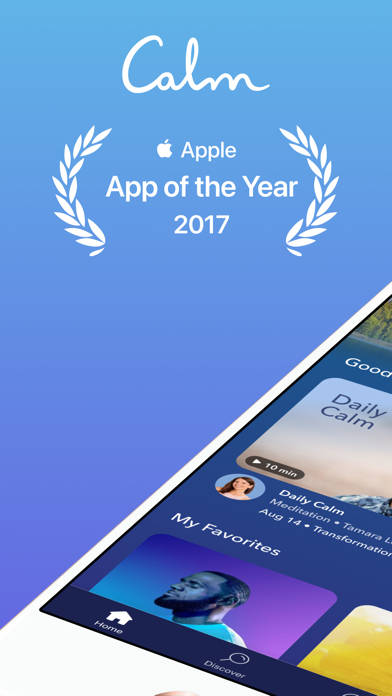
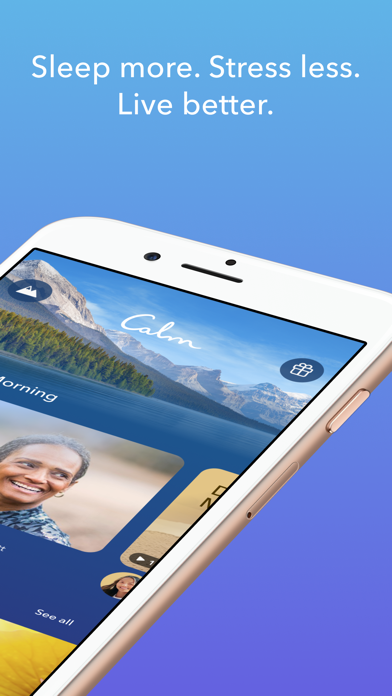
Calm is a self-guided meditation, sleep and relaxation app available on iOS, Android and the web. The core of the product is audio: guided meditation sessions ranging from a few minutes to half an hour, breathing exercises, soundscapes (rain, fireplace, cafe noise), and the Sleep Stories. There are also some short courses on topics like managing stress and focus, plus a daily mood check-in.
It is firmly in the relaxation-first camp. There is no habit builder, no meaningful journaling, and no AI companion. That focus keeps the app simple to use — you open it, pick something, press play — but it also sets a ceiling on how far it can take you if you want to work on behaviour change, self-reflection, or personal growth in a broader sense.
Calm was developed by Calm.com, Inc. and is one of the most downloaded apps in its category. It runs on all major platforms and syncs with Apple Health and Google Fit.
Getting started: first run to first session
Setup is quick. You choose a few focus areas (sleep, stress, anxiety, personal growth) and set a reminder, and then you're on the home screen. There's no detailed quiz or adaptive intake — the personalisation is light, more 'pick a category' than 'here's your plan'. That keeps friction low, which suits people who want to try something immediately rather than configure their way to it.
Time to first value is 4 out of 5 in our scoring. Within five minutes of downloading, you can be midway through a breathing exercise or a Sleep Story. For someone who simply wants to decompress tonight, that responsiveness is exactly right.
The no-cost content is limited — some free sessions and a daily meditation — but the majority of the library sits behind Calm Premium. A free trial is commonly offered on the annual plan; confirm current availability in the App Store or Google Play.
Sleep Stories: where Calm earns its reputation
If Calm has one standout feature, it's Sleep Stories. These are narrated audio stories — some fictional, some travel-based, some just descriptive — voiced by recognisable names and mixed with gentle ambient sound. They are engineered to be interesting enough to distract an overactive mind but not so gripping that you stay awake to find out what happens. That sounds like a modest brief, but it works.
The library of stories is broad, with varying lengths and tones. Some run 30 minutes, some longer; some are for adults, some for children. They've become a genuine selling point that competitors have tried to replicate without quite matching the production quality or the breadth.
If you have trouble shutting off racing thoughts at bedtime, this is one of the most practical tools in the app-store ecosystem for that specific problem. It's the clearest case where Calm delivers something concrete and repeatable.
Meditations, breathing and soundscapes day-to-day
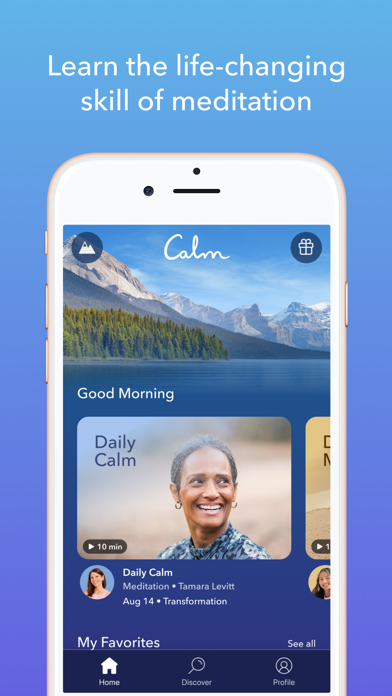
Outside of sleep, the daily meditation library is solid. Sessions are organised by length and theme — morning calm, focus, anxiety, gratitude and more — and the production standard is consistent. The Daily Calm, a new guided session each day, gives you a reason to open the app even when you're not struggling with sleep.
Breathing exercises are simple and well-executed. You get a small animated visual to follow, timed inhale and exhale cues, and a brief guided element. Nothing revolutionary, but reliable. Soundscapes — rain, ocean, fan, ambient noise — are useful for focus as well as sleep and can be mixed and layered.
The mood check-in is minimal: a quick tap to log how you're feeling. It's enough to track a general trend but nowhere near the depth of a dedicated mood or journaling app. Treat it as a light habit anchor rather than a reflection tool.
Courses and structured learning
Calm includes a selection of multi-session courses on topics like the basics of meditation, managing stress, and building focus. These are step-by-step audio programmes rather than interactive modules, and they provide some structure for beginners who want to understand what they're doing rather than just press play.
That said, the course depth is modest compared to what Headspace or Liven offer. Headspace, in particular, has invested heavily in structured learning paths with a clearer progression. Calm's courses are useful as an on-ramp but won't substitute for an app that treats guided growth as its primary mission.
Method and credibility
Calm's approach draws on mindfulness and relaxation practices with some reference to sleep science — breathing techniques, progressive muscle relaxation and body-scan styles appear across the content. What it doesn't do is name specific clinical frameworks such as CBT, ACT or DBT in the way that apps like Wysa or Liven do.
That's a meaningful distinction. Mindfulness has a genuine evidence base for stress and sleep, but Calm presents it as wellness content rather than clinically validated programming. For everyday stress relief and better sleep habits, that's probably fine. For anyone dealing with more than everyday stress, a framework-grounded approach would be more appropriate — and Calm is not that app.
The credentials score in our rubric reflects this: solid but not exceptional. Calm is well-made and broadly credible; it isn't making strong clinical claims, which is accurate of what it offers.
Pricing and what you actually get
Calm Premium costs around $69.99 per year at the time of writing — confirm the current price in the App Store or Google Play, as it can vary. An occasional lifetime offer exists at around $399.99, though availability changes. A free trial is commonly offered on the annual plan; check whether one is available when you sign up.
The no-cost content is genuinely limited. A handful of meditations, the daily meditation, and some breathing exercises are all you get without paying. The bulk of the Sleep Stories, the extended course library, and the soundscape collection all sit behind Premium. If the Sleep Stories are your main draw, the economics only make sense if you'll actually use them regularly.
Set a reminder before your renewal date. As with most annual plans, the charge rolls over automatically. Cancel through your App Store or Google Play subscription settings.
Where Calm struggles past week two
Stickiness is where Calm's score drops relative to its overall rating. We give it a 3 out of 5 on that measure — respectable but not strong. The root cause is limited personalisation. After a few weeks, there's no adaptive element pulling you toward content matched to your progress or goals. The home screen looks much the same on day 60 as it did on day 3.
There's no habit builder to give you something to come back for, no journaling to process what the sessions bring up, and no companion or community dimension. The Daily Calm helps as a lightweight hook, but users who need external structure to maintain a practice may find it fades from their routine.
This isn't a flaw unique to Calm — it's a trade-off the app makes by staying focused on audio content. The question is whether that trade-off suits your personality. If you're self-directed and will return to the library by choice, the depth of content is there. If you need the app to nudge you back, you may need something more structured.
How Calm compares to Headspace, Balance and Liven
Against Headspace, Calm's closest direct rival, the comparison is close. Headspace has stronger structured courses and a higher evidence score in our rubric; Calm has better Sleep Stories and a marginally more soothing design. Headspace scored 4.4 to Calm's 4.2 in our ranking. If you're primarily a sleep user, Calm's edge is real; if you want to learn to meditate systematically, Headspace is the better teacher.
Balance, from Elevate Labs, beats both on personalisation — its adaptive session system adjusts to your experience and goals in a way Calm doesn't attempt. But Balance has a smaller content library and less of a sleep focus. It's a better fit if personalisation matters more than volume.
Liven, our current top pick, operates in a different category. It's an all-in-one self-discovery app — mood tracking, journaling, guided courses, a habit builder, and an AI companion — rather than a meditation and sleep specialist. If you want Calm's core use case done well, Calm delivers it better than Liven. If you want a single app to cover your broader personal development, Liven's breadth wins. The two aren't really competing for the same user.
Privacy and data
Calm collects usage data and, at its scale, works with third-party analytics and advertising partners in ways that are standard but worth understanding before you hand over health-adjacent information. The privacy policy is publicly available on their website and is the authoritative source — read it before subscribing, and check for updates periodically.
There's no end-to-end encryption for your content in the way a journaling app might offer, partly because Calm doesn't hold sensitive personal reflections — your mood check-ins are minimal. The main data questions are around usage analytics and account data rather than deep personal disclosures.
Maker: Calm.com, Inc. · Platforms: iOS, Android, Web · Approach: Self-guided · Methods: mindfulness, relaxation, sleep
Calm plans & pricing
Free tier: Some free content; most is paid.
Trial: Free trial commonly offered on the annual plan.
Prices approximate, as of June 2026 — verify on the App Store / Google Play. The bulk of meditations, Sleep Stories and music require Calm Premium.
Cancellation: Cancel through your app-store subscription. As with most annual plans, set a reminder before renewal.
Feature checklist
- Mood trackingYes
- JournalingDaily check-in
- AI companion—
- Courses & lessonsYes
- MeditationsYes
- Soundscapes / focus musicYes
- Habit & routine builder—
- RemindersYes
- Quiz / assessment—
- Community—
- Live coaching—
- Crisis resourcesYes
- Data export—
- Apple Health / Google FitYes
- Home-screen widgetsYes
- Offline useYes
Calm pros & cons
What's good
- Sleep Stories are genuinely good — voiced, cinematic, and effective at quieting a restless mind
- Interface design scores the highest of any app we tested; it's calm by design, not just by name
- Offline playback means you're not dependent on a signal at bedtime
- Covers a solid range: guided meditation, breathing exercises, soundscapes, light mood check-in and some courses
- App Store and Google Play ratings are both high (around 4.8 and 4.4 respectively, at the time of writing), suggesting the mainstream audience finds it delivers
- Health app sync works on both platforms
What to weigh up
- Personalisation is thin — there's no real diagnostic or adaptive plan, just a library to browse
- No habit builder, no journaling depth, no AI companion; it does fewer things than rivals at the same price
- Stickiness drops off after the first few weeks once the novelty of the content wears off
- The annual plan (around $69.99 at the time of writing) is the same price as Headspace's annual plan, despite offering a narrower feature set
- No community or live sessions — everything is solo, which suits some users and not others
Support
Calm offers a help centre and email support. In-app support access is straightforward, though response times for account queries — particularly around billing — may vary. Check the help centre first; most common questions about subscriptions and cancellation are covered there.
Method & credibility
Calm leans on mindfulness and relaxation techniques with some grounding in established sleep-science principles, but it does not prominently name specific therapeutic frameworks such as CBT or ACT in its core product. The approach is more wellness-oriented than clinically structured, which is fine for everyday stress and sleep but means the evidence base is thinner than apps that cite named frameworks explicitly.
Privacy & data
Calm collects usage data and, depending on your settings, may share information with third-party analytics partners — standard practice for apps at this scale, but worth checking. Read Calm's privacy policy before subscribing, particularly if you intend to use the app for sensitive or health-adjacent reasons; policies can change and the current version on their website is the authoritative source.
Third-party ratings
- 4.8 / 5 on App Store — as of June 2026, verify
- 4.4 / 5 on Google Play — as of June 2026, verify
We report independent ratings with their source and date and never invent them. Figures here are approximate and pending verification before launch.
Our data: Calm
Two numbers we measure ourselves, on the same 1–5 scale for every app — the things most roundups never score (see all 20 on the compare page):
Calm FAQ
Is there a no-cost version of Calm worth using?
There is some no-cost content — a daily meditation, a few guided sessions, and basic breathing tools — but the majority of what makes Calm worth using, including Sleep Stories and the course library, requires Calm Premium. The no-cost tier is better treated as a trial than a standalone product.
How does Calm compare to Headspace for sleep?
Both have strong sleep content, but Calm's Sleep Stories are generally considered the standout feature in the category. Headspace offers Sleepcasts and sleep meditations that are solid, but Calm's depth and variety in sleep audio give it the edge for that specific use case.
Can I use Calm offline?
Yes. Downloaded content plays without an internet connection, which matters for travel or if you don't want your phone connecting to anything at bedtime. You'll need to download sessions while connected first.
Does Calm help with anxiety?
Calm includes meditations and breathing exercises designed for stress and anxious feelings, and mindfulness techniques have a genuine evidence base for everyday anxiety. It is not a clinical tool and is not a substitute for professional support. If your anxiety is significantly impacting your daily life, speak to a qualified professional.
Is Calm worth it if I already use another meditation app?
Mainly for the Sleep Stories. If your existing app covers your daytime meditation needs and you're looking for something to improve sleep specifically, Calm's sleep library is distinct enough to be worth adding. As a full replacement for another well-featured app, the overlap may not justify the cost.
How do I cancel Calm Premium?
Cancel through your App Store (iOS) or Google Play (Android) subscription settings — not through the Calm app itself. Set a reminder a few days before your renewal date so you don't get charged for another year unintentionally.