
Blinkist Review: 2026 Overview
The verdict
3.9/ 5 Thousands of nonfiction books distilled to fifteen minutes each, in text and audio.
Blinkist does one thing well: it gets the core ideas of a nonfiction book into your head in about fifteen minutes. That is genuinely useful if your current reading count is low and you want it higher. Where it falls short is depth and personalisation — there is no guided path, no behaviour-change layer, and no real stickiness mechanism beyond your own discipline. At around $99.99 a year (at the time of writing), it is a solid investment for committed learners but harder to justify if you tend to lose momentum after the first week.
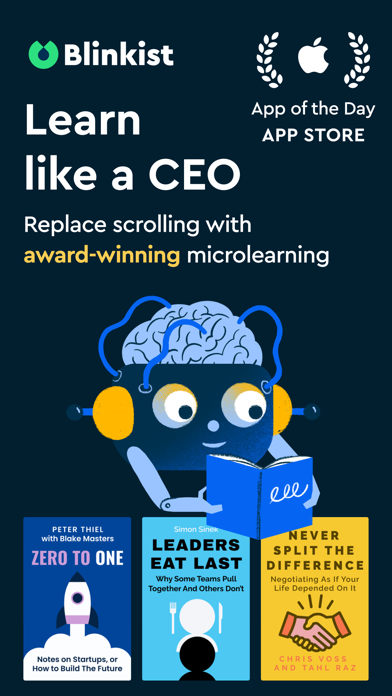
Blinkist was built around a straightforward observation: most people buy more books than they finish, and the gap between purchase and completion is enormous. Its answer is to strip each nonfiction title down to its key ideas and present them in roughly fifteen minutes, either as text or narrated audio. The library runs to several thousand titles across business, psychology, habits, health and related subjects — enough to keep a curious reader occupied for a long time.
It sits squarely in the microlearning category, which makes it a very different proposition from an app like Liven or Headspace. There is no emotional-support layer, no guided programme that adapts to your mood or goals, and no AI companion checking in on you. What you get is a well-executed reading tool. Whether that is enough depends entirely on what you opened the App Store looking for.
What Blinkist actually is (and is not)
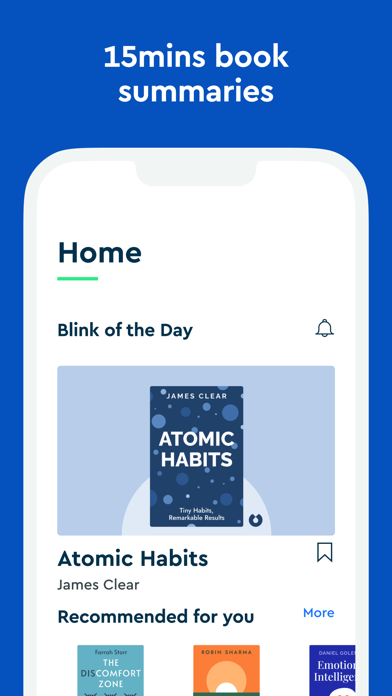
Each summary — Blinkist calls them Blinks — runs to about fifteen minutes of reading or listening. The structure is consistent: a short introduction, a series of key ideas each given a paragraph or two, and a brief close. It reads closer to a structured extract than a traditional summary, which means you get the argument of the book rather than just its topics.
Blinkist is not a self-improvement coach, a habit tracker, or a mood tool. It has no assessments, no journaling, and no mechanism to help you apply what you read. The implicit assumption is that you will take ideas and act on them yourself. For some people that works; for others, the absence of scaffolding means insights stay theoretical rather than becoming behaviour.
Getting started: first run to first summary
Setup is quick. You create an account, pick a handful of interest categories, and you are inside the library within two or three minutes. There is no lengthy quiz funnel, no layered onboarding, and no upsell screen before you reach the content. The daily no-cost pick is right there on the home screen. Our time-to-first-value score for Blinkist is 4 out of 5 — you reach something genuinely useful fast.
The trial on Premium is straightforward to activate. The main practical risk is forgetting to cancel before it converts: check the renewal date and set a reminder, because the annual plan at around $99.99 is not trivial to absorb accidentally. Always confirm current pricing in the App Store or on the Blinkist website before subscribing.
The home screen shows curated collections, trending titles and your recent picks. Browsing is fine but relies on editorial curation rather than personalisation. You can search by title or author, and most well-known personal-growth and business titles are present. Older or more specialist books are patchier.
The reading and listening experience
The text layout is clean and generous — comfortable to read on a phone without adjusting text size. Each key idea gets its own screen, which keeps you moving forward rather than staring at a wall of prose. You can switch between text and audio mid-summary, and the narration is a real human voice rather than a synthesised one, which matters over a fifteen-minute listen.
Offline mode works as advertised. Download a queue of summaries over wifi and they play back without a connection. For commuters with patchy signal, that is a practical edge some competitors do not reliably match.
The web app deserves a mention because it is genuinely polished, not an afterthought. If you spend time at a desk, reading summaries in a browser tab is comfortable and fast. That cross-platform parity is a real strength.
Library breadth and editorial quality
The catalogue is large. Business, leadership, psychology, habits, productivity and health are the strongest sections. Self-help classics are well covered. The summaries are written to a consistent standard — they do not pad or sensationalise, which is not guaranteed in this category.
Weaker areas include newer releases and more specialist titles, where there can be gaps of several months before a summary appears. Some older summaries also feel static — accurate but stripped of context a newer reader might benefit from. There is no user-facing mechanism to request an update or flag an issue, which is a small but real frustration over time.
Where the stickiness falls short
Our stickiness score for Blinkist is 3 out of 5, and that reflects something structural. The app has no mechanism to draw you back beyond a daily notification and the daily no-cost pick. No streaks, no learning paths that feel incomplete until you continue, no companion that notices you have been away. Whether you open the app tomorrow depends on your motivation alone.
That is not a problem for every user — disciplined readers who want a library to dip into will not miss these features. But if you are trying to build a consistent learning habit from scratch, Blinkist's low-friction content also means low-friction abandonment. It asks very little of you, which also means it does not hold you to anything.
Method and credibility
Blinkist makes no claims to being evidence-based in a therapeutic sense. Its editorial team curates and condenses nonfiction books — the credibility of any given summary depends on the credibility of the source book, which varies enormously across the library. A summary of a rigorous psychology title and a summary of a popular self-help book will sit side by side with no meaningful distinction between them.
That is the honest limitation of the format. Blinkist is a reading-efficiency tool, not a behaviour-change programme. Go in expecting the former and you will get real value. Go in expecting the latter and you will be looking for something this category simply does not provide.
Pricing and what Premium actually covers
The no-cost tier gives you one daily pick — functional for occasional sampling but too limited to form a proper reading habit. Premium, at around $99.99 a year at the time of writing, unlocks the full library, audio and offline access. Confirm current pricing in the App Store or on blinkist.com before subscribing, as promotional rates and bundled deals appear periodically.
Value is use-dependent. If you finish five or six summaries a week, the per-summary cost works out low. If you open the app three times and drift away, the annual price is hard to justify. There is no cheaper monthly option visible in the standard listing — another reason to be certain before committing to a year.
Blinkist versus Headway
Headway is the most direct competitor — both offer short nonfiction summaries with audio, both sit at a similar price point. Headway leans harder into personalisation: it sets daily reading goals, tracks streaks, and tries to surface books relevant to your declared growth areas. Our stickiness score is 3 for both, but Headway's nudge layer makes it marginally more likely to pull you back on a slow day.
Blinkist's advantages are the larger, more mature library and a noticeably better web experience. Headway's premium runs around $89.99 a year versus Blinkist's roughly $99.99 at the time of writing — confirm both in-store, as these figures shift. Neither is a clear overall winner; it comes down to whether you prioritise library size or habit scaffolding.
How Blinkist sits against Liven
Liven and Blinkist occupy different categories, so a direct swap only makes sense for a narrow group. Liven is an all-in-one platform — mood tracking, journaling, habit building, courses, an AI companion — while Blinkist is strictly a reading tool. Across almost every criterion in our scorecard, Liven scores higher for broad personal development.
Where Blinkist genuinely beats Liven is sheer volume of distilled ideas. Liven has a course library, but it does not have thousands of book summaries. Some users run both in parallel: Blinkist for reading breadth, Liven for daily guided practice. The overlap is small enough that they do not step on each other much.
Privacy
Blinkist collects account data and reading behaviour. Following its acquisition and integration with Go1, the data handling context has expanded beyond a standalone consumer app. Read the current privacy policy at blinkist.com before subscribing — policies change, and this review cannot substitute for the current terms.
Verdict: who should get Blinkist
Blinkist is a well-made tool for a specific use case: absorbing the ideas from nonfiction books efficiently, without committing to reading them in full. The library is broad, the audio is good, and offline mode works. If that matches your actual goal, it earns its place.
It is a harder sell if you want something that actively supports your personal development beyond information intake. No habit layer, no personalisation engine, no stickiness mechanism past your own willpower — our score of 3.9 out of 5 reflects both the genuine quality and the real ceiling. Take the trial, set a renewal reminder, and be honest about how often you will actually open it.
Maker: Blinkist (Go1) · Platforms: iOS, Android, Web · Approach: Self-guided learning · Methods: microlearning
Blinkist plans & pricing
Free tier: Limited free (a daily pick); full library behind a subscription.
Trial: Free trial on Premium.
Prices approximate, as of June 2026 — verify on the App Store / Google Play. The full library, audio and full-text summaries need Premium.
Cancellation: Cancel through your app-store or web subscription; check the renewal date after the trial.
Feature checklist
- Mood tracking—
- Journaling—
- AI companion—
- Courses & lessonsYes
- Meditations—
- Soundscapes / focus music—
- Habit & routine builder—
- RemindersYes
- Quiz / assessment—
- Community—
- Live coaching—
- Crisis resources—
- Data export—
- Apple Health / Google Fit—
- Home-screen widgetsYes
- Offline useYes
Blinkist pros & cons
What's good
- One of the largest summary libraries available, spanning business, psychology, health and personal growth
- Both text and audio for every summary — narration is human-voiced, not robotic, and holds up across a full commute
- Clean, distraction-free reading experience; the web app is as good as mobile
- Offline mode lets you queue summaries before a flight or run
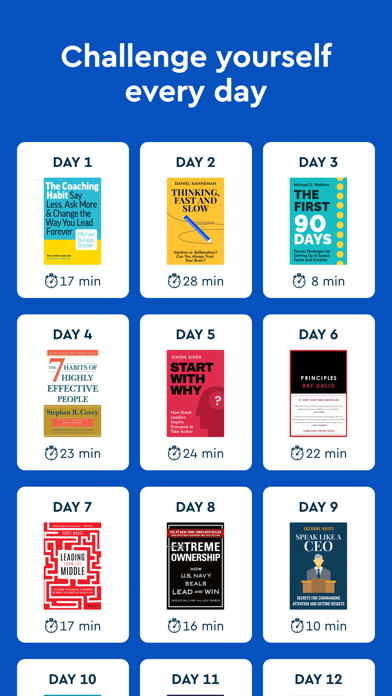
- Time estimate shown upfront so you can pick a summary that fits a ten-minute gap
- Store ratings solid — around 4.7 on the App Store and 4.5 on Google Play at the time of writing
What to weigh up
- Premium costs around $99.99 a year, with only a single daily no-cost pick on the basic tier — the paywall is high relative to what you can preview
- No personalisation engine: the app does not learn what you have read, adapt to your goals, or suggest a next step in any meaningful way
- Summaries are fixed snapshots — some older titles feel dated and there is no way to flag or request an update
- No habit builder, mood tracking, journaling, or guided programme — it is strictly a reading tool
- Stickiness relies entirely on the user: no streaks, no companion, no social layer to draw you back
Support
Blinkist offers email support and a written help centre; response times are not published, but user accounts suggest replies within a business day or two. There is no live chat option.
Method & credibility
Blinkist is a distillation service, not a therapeutic framework. Summaries are written by an editorial team rather than derived from a named evidence-based method such as CBT or ACT. The credibility of any given summary depends on the credibility of the source book, which varies across the catalogue.
Privacy & data
Blinkist collects reading behaviour and account data; following its integration with Go1, an enterprise learning platform, the data architecture is worth understanding before subscribing. Read the current privacy policy at blinkist.com rather than relying on this review, particularly if you are concerned about third-party data sharing.
Third-party ratings
- 4.7 / 5 on App Store — as of June 2026, verify
- 4.5 / 5 on Google Play — as of June 2026, verify
We report independent ratings with their source and date and never invent them. Figures here are approximate and pending verification before launch.
Our data: Blinkist
Two numbers we measure ourselves, on the same 1–5 scale for every app — the things most roundups never score (see all 20 on the compare page):
Blinkist FAQ
Is there a no-cost version of Blinkist?
There is a limited no-cost tier that gives you one daily pick from the library. It is enough to try the format but not enough to build a reading habit. The full library requires a Premium subscription, currently around $99.99 a year — confirm the current price in the App Store or on blinkist.com.
Can I listen to summaries offline?
Yes. You can download summaries over wifi and play them back without a connection. That is one of Blinkist's practical advantages over some competitors, and it works reliably on both iOS and Android.
How long is each summary?
Most run to about fifteen minutes of reading or listening, with a range of roughly ten to twenty minutes depending on the source book. The time estimate is shown upfront so you can pick something that fits a short gap.
Does Blinkist help with habit building or personal growth beyond reading?
Not directly. It is a reading-efficiency tool. There is no habit tracking, mood logging, journaling, or guided behaviour-change programme. If those features matter to you, an all-in-one app like Liven or a habit-focused tool like The Fabulous is a better fit.
How does Blinkist compare to just reading a summary online?
Blinkist summaries are more structured and consistent than most you would find through a search, and the audio narration is human-voiced rather than synthesised. The value is in library breadth, editorial consistency and offline access — not in any one summary being dramatically superior.
What happens if I cancel after the trial?
You revert to the no-cost tier — one daily pick. Saved summaries and notes may not all remain accessible. Cancel through your App Store or Google Play subscription settings before the trial ends to avoid being charged for the annual plan.